
The challenge
Following the launch of the Simulated Consultation Assessment (SCA), GP registrars consistently asked for more opportunities to practise consultation skills before taking the examination.
RCGP already provided highly valued preparation resources and courses, but there was an inherent capacity challenge. Realistic consultation practice traditionally requires cases, role players or facilitators, scheduled sessions and significant delivery resource. It is difficult to provide repeatedly and on demand at the scale required for a national assessment.
Candidates could seek additional preparation from commercial providers, but this could involve significant personal cost and did not address the underlying challenge of equitable access to repeated practice.
The question was therefore broader than how to provide more preparation content:
Could AI give candidates realistic consultation practice whenever they needed it, allow them to practise repeatedly, and provide meaningful individual feedback — while maintaining the educational quality and authenticity expected of a high-stakes clinical assessment?
Exploring the opportunity
As SCA Programme Lead, CX Works founder Liam Wynne led the exploration of whether emerging generative AI technology could provide a different approach.
The work started with the candidate and educational need rather than a predetermined technology solution. RCGP worked closely with two potential technology partners to explore how AI could simulate a clinical consultation and support meaningful formative feedback.
Different approaches were developed, including both a visually simulated patient and a voice-based AI patient. This provided an opportunity to consider not just the underlying technology, but the experience that would work best for candidates.
Designing the learner experience
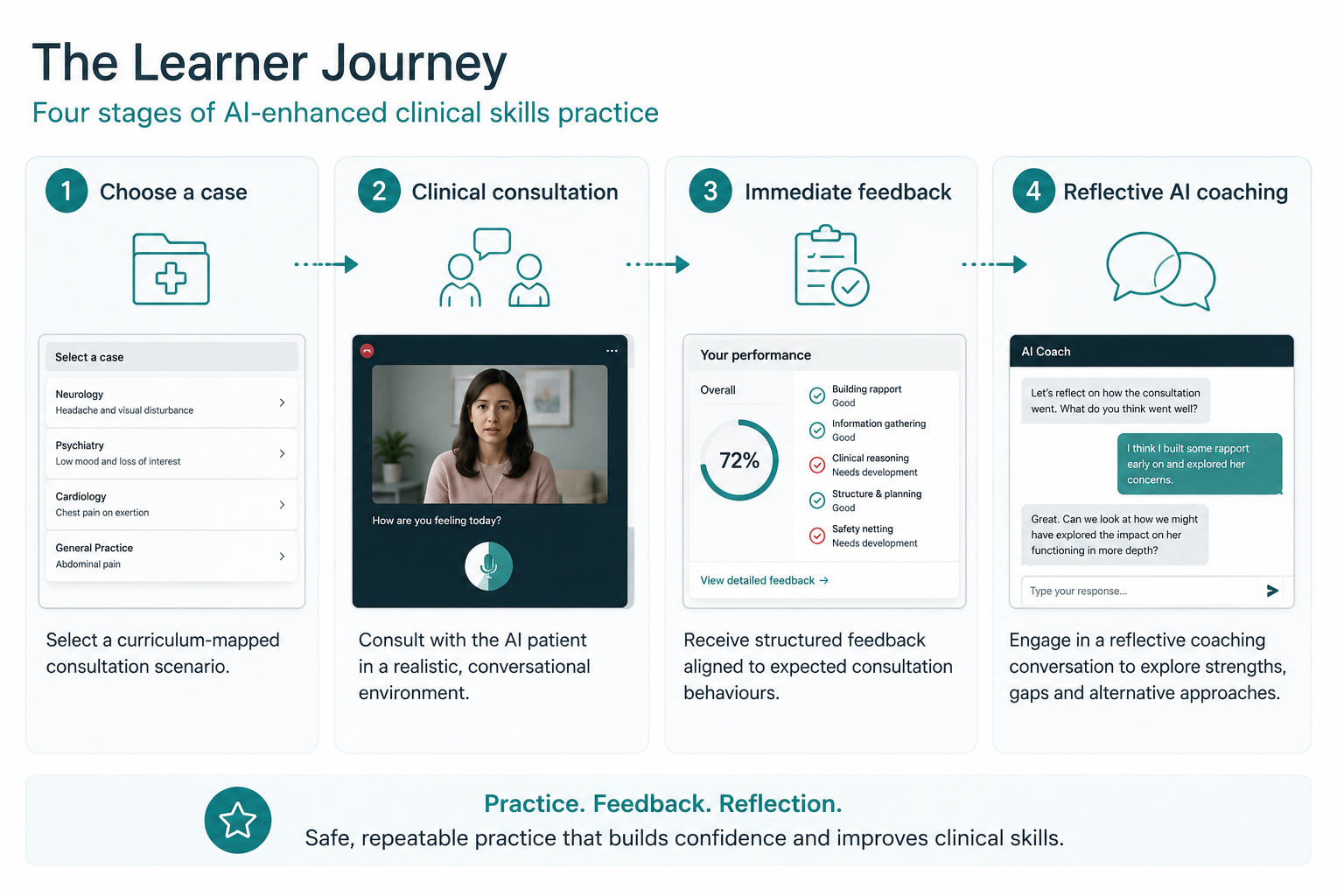
The concept centred on a simple learning cycle: candidates would choose a relevant clinical scenario, undertake a realistic consultation with an AI patient, receive structured feedback, and then have the opportunity to explore their performance through a reflective AI coaching conversation.
The exploration demonstrated that greater technological sophistication did not necessarily result in a better learner experience. Although a simulated visual patient initially appeared attractive, the voice-based interaction created a more natural environment in which the candidate could concentrate on the consultation itself.
The SCA also provided strong foundations for AI-enabled practice. Its detailed cases, role-player briefs, consultation expectations and structured assessment domains could be translated into the prompts and educational scaffolding needed to create realistic practice and relevant feedback.
Selecting a partner and piloting the solution
Alongside the quality of the learner experience, the ability to develop, iterate and move quickly into testing was important.
risr demonstrated a strong voice-based approach and was able to progress rapidly towards a substantive pilot. RCGP selected risr's AI Clinical Coach for the next stage and formalised the collaboration through an MOU.
The pilot combined an AI patient for consultation practice with an optional AI coach through which candidates could reflect on their performance, explore feedback and identify areas for improvement.
What happened
Candidates who engaged with the pilot used the technology meaningfully and repeatedly, completing an average of three cases each.
On average, participants spent approximately 10 minutes 45 seconds consulting with the AI patient and a further 4 minutes 45 seconds with the optional AI coach.
Most significantly, 95% of survey respondents agreed that using the tool increased their insight into their own strengths and weaknesses.
The pilot also provided important learning for further development. Response latency, consultation flow and occasions when the AI patient anticipated expected consultation behaviours could all affect the realism of the experience. The findings therefore helped identify where the technology and experience needed further refinement.
The CX Works perspective
AI creates the opportunity to make high-quality practice far more accessible and repeatable, but the technology is only one part of the solution.
Effective AI-enabled practice starts with understanding the learner problem and designing the right experience around it. It requires strong content and assessment design, thoughtful use of AI, appropriate supplier selection, subject-matter oversight, quality assurance and evaluation with real learners.
This project also demonstrated an important principle: more sophisticated technology does not automatically create a better experience. The right solution is the one that best supports the learner and the purpose of the interaction.
CX Works brings together assessment expertise, candidate experience, digital transformation and supplier leadership to help organisations move from an AI opportunity to something that can be tested and used in practice.
Define the problem. Design the experience. Select the right technology. Pilot with learners. Evaluate and refine.